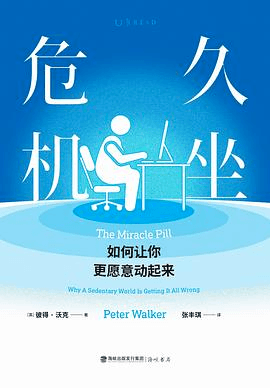
I have lived with recurring lower-back pain from lumbar muscle strain for years. So when I came across Peter Walker's The Miracle Pill: Why a Sedentary World Is Getting It All Wrong, I bought it almost immediately. The Chinese edition is titled The Sedentary Crisis. It is not a literal translation, but it captures the warning at the center of the book.
This is not a chapter-by-chapter summary. I want to pull out the ideas that changed how I think about movement and place them beside my own experience. My main takeaway is simple: for most people, better health may depend less on completing a strict fitness program than on putting movement back into ordinary life.
You do not need to be a specialist to write a serious book
The first thing that surprised me was Walker's background. He is not a medical researcher or a public-health professor. He is a political journalist.
Driven by curiosity and personal need, he interviewed researchers across health-related fields, connected their findings, and built an informed account of movement in modern urban life. He identifies problems that are often ignored and offers plausible explanations and practical responses.
That fact is instructive on its own. A person with sound reasoning, strong writing, and enough general knowledge can enter an unfamiliar field, learn carefully, interview the right people, verify the evidence, and produce knowledge that others can use.
Why do we need to be healthy?
The answer appears obvious. Yet if it were truly obvious in practice, why would so many of us repeatedly choose things that work against our health?
There is a bleak saying in high-pressure workplaces: spend the first half of your life trading health for money, then spend the second half trading money for health. It sounds absurd, but it has enough reality behind it to be uncomfortable. It also points to something easy to postpone: health has to be a lifelong pursuit.
Health gives us the capacity to enjoy life without being constantly limited by pain. As we age, the risks associated with poor health rise as well. The earlier we notice what harms us and change the conditions around it, the more likely we are to retain a good quality of life later on.
Why are our bodies becoming less healthy?
The intuitive answer is usually, "I do not exercise enough," or more specifically, "I cannot stick to a workout routine." Health is one of the rare subjects where people are quick to blame themselves and slow to examine their surroundings.
But many forces shape our health. If we understand them, we can ask a better question: beyond demanding more discipline from ourselves, what conditions do we need in order to stay healthy?
Modern life narrows the ways we use our bodies
As the Chinese title of the book suggests, sedentary work is a major health risk in urban life.
Human bodies evolved through a long period in which movement was unavoidable. Against that history, the modern habit of keeping the body still for most waking hours is extremely recent. If we hold ourselves in one position for a large part of our lives, the body eventually answers with pain or illness.
I once organized my life almost entirely around saving time. I lived close to the office and even bought an electric scooter for the commute. I joked that my daily task was simply to transport my brain to work. I did not realize that this convenience was also helping create the conditions for my back pain.
Sitting is especially harmful when our posture loads the same muscles for long periods, causing inflammation and pain. The research discussed in the book also connects prolonged inactivity with insulin resistance and the risk of type 2 diabetes. The most direct response is equally simple: move.
"Move" does not necessarily mean sweating in a gym or training for a marathon. Walker's evidence suggests that ordinary physical activity can matter on its own.
That activity can include:
- cycling to work;
- taking the stairs instead of the lift;
- standing up and moving after a long period of sitting.
Once we begin noticing which moments in daily life could involve our bodies rather than an automated convenience, we are already moving toward a healthier way of living.
Personal health is not only a personal matter
Consumer culture often sells us a particular image of the successful professional: work with complete intensity during the day, then spend the evening in a gym, maintaining both exceptional performance and a visibly fit body.
This turns health into a combined test of purchasing power and willpower. But our daily energy is limited, and work may already consume too much of it. The work-plus-gym ideal is possible for some people, but it also encourages many others to treat every consequence of inactivity as a personal moral failure.
Weight creates another trap. The familiar advice is to eat less and move more. When people cannot sustain one half of that formula, or when the number on the scale does not move quickly, they may abandon both.
The evidence presented in the book suggests that it is more useful to separate movement from weight loss. Excess weight can carry health risks, but physical activity still produces benefits even when it does not immediately make someone thinner. The relevant question is whether the person keeps moving.
If difficulty going to the gym and frustration about weight are internal reasons people stop exercising, external conditions are just as important. Health is also a question of urban planning, architecture, and public space.
Does a city genuinely invite its residents to move? The answer is not found in public slogans. It is visible in whether streets are pleasant and safe to walk, and whether cycling or walking is treated as a normal way to travel.
The book gives a revealing account of the playground. Before cars became common, children could play in the street. Once motor traffic made that dangerous, cities set aside a designated area for children's movement: the playground.
The story shows how social development can quietly take away shared space for ordinary activity.
I often see pavements and tactile paths blocked by cars and shared bicycles. Pedestrians are forced through narrow scraps of space, where walking becomes something to endure rather than enjoy. It is not surprising that more people then choose cars.
Walker also tries to make movement part of daily life by taking the stairs. Yet in some buildings the stairs are hidden, unwelcoming, or impossible to follow all the way through. I have had the same experience. Architecture can say that movement is desirable while designing it out of the building.
Mental health belongs in the same discussion
Many barriers to movement are visible: a desk, a car, a blocked pavement, an inaccessible staircase. Another barrier is quieter. Some people stay seated because they are lonely.
Television, games, and short-form video can offer relief from loneliness, but they also make it easy to remain still for hours. As populations age and economic pressure grows, I suspect this connection between psychological distress and physical inactivity will become more important.
People with broad social circles may leave home to meet friends and naturally spend less time sitting. What alternatives exist for an introverted person? Beyond repeatedly forcing oneself to move, can we create routines and social environments that protect mental and physical health together?
There is no simple answer, but the question deserves more attention.
How can we protect our health?
Put movement into daily life
The most durable answer is to make movement part of ordinary life.
Almost any form of activity can help. The practical task is to study our own routines and find more moments when the body can participate, instead of treating exercise as a separate appointment that must always compete with work and fatigue.
A few practical suggestions
Drawing on the book and my own experience:
- Walk or cycle for at least part of the commute when possible. When walking, try a brisk pace. A useful measure is that you can talk, but you may not be able to sing.
- If your work requires long periods of sitting, set a reminder to stand up, walk around, and stretch at intervals.
- Take the stairs when they are available, and notice which modern conveniences are quietly removing movement from your day.
The most important part is to work with the life you actually have. Keep asking which forms of movement are realistic enough to repeat. As the book puts it, the best exercise is:
The exercise you will do and keep doing.
Closing thought
The Miracle Pill changed how I think about exercise. Movement is not only a specialized task performed inside a gym, and health is not merely the outcome of individual willpower.
Physical inactivity is a public-health crisis. Once we see it that way, the useful response is not another grand plan. It is to start today, in the gaps between commuting, working, and living, and let the body move again.